Why U.S. Distributors Are Switching from Palm Leaf Plates to Bagasse Plates
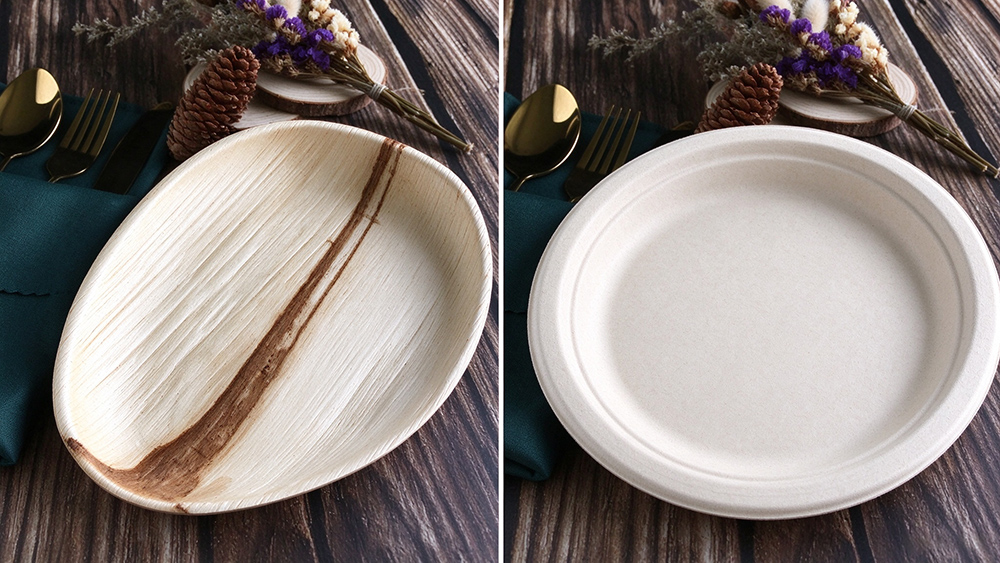
Over the past two years, a clear shift has appeared on the purchasing lists of U.S. disposable tableware distributors: orders for palm leaf plates are shrinking, while SKUs for bagasse plates are increasing. This is not a shift in aesthetic preference. It is a structural replacement driven by cost, compliance, and supply chain stability.
Palm Leaf's Good Looks Can't Fix Its Production Problems
Palm leaf plates have always had a clear position in the U.S. market: weddings, banquets, high-end events. Their natural texture and heavy hand feel are visually flawless. But distributors are not serving one wedding. They are serving hundreds of clients who need regular restocking.
The supply bottleneck for palm leaf lies in the raw material itself. Palm leaves are naturally fallen fronds. Collecting, washing, and heat-pressing each step depends on manual labor and origin. Output is limited by season and geography. Specifications vary from batch to batch. Sizes and colors differ slightly every time. For distributors who need stable inventory and predictable lead times, this is not "natural beauty." This is operational risk.
Bagasse plates come from sugar mills. The fibrous residue left after sugarcane is crushed for juice was once burned or composted as waste. Sugar mills run year-round. Fiber supply is stable. Mold pressing delivers uniform size and consistent thickness. Distributors don't have to explain to clients why the plates are darker this time.

PFAS Bans Are Reshuffling the Competition
What really changed the game is regulation.
In February 2024, the FDA announced a ban on PFAS (per- and polyfluoroalkyl substances) in food packaging as a grease-proof coating. PFAS are called "forever chemicals" and are linked to health risks. Since then, multiple states have rolled out their own PFAS restrictions: California effective 2025, New York effective 2025, Washington effective 2026, Maine effective 2030.
What does this mean for distributors? Products that once relied on coatings to solve grease resistance must now rely on the material itself. Bagasse fiber has inherent oil resistance. It does not need a chemical coating to hold greasy food. Products that cannot move away from PFAS are being removed from distributor catalogs.
Distributors don't want "the most eco-friendly story." They want products that won't trigger customer complaints, won't get stuck with regulators, and won't be held at customs. PFAS-free bagasse plates meet that requirement.
Cost Gaps Get Magnified in High-Frequency Purchasing
On unit price alone, palm leaf plates cost more than bagasse plates. But distributors don't calculate unit price.
Palm leaf plates are bulky and heavy. Freight costs are high. Bagasse plates nest and stack. The same container volume holds more units. For distributors moving dozens of containers a month, the landed cost gap after freight dilution matters more than a few cents on the FOB quote.
More important is repeat purchase rate. Palm leaf plate customers are event planners and wedding venues. Purchasing is project-based, low frequency, small batch. Bagasse plate customers are cloud kitchens, takeout restaurants, and corporate cafeterias. Purchasing is weekly or monthly. Once a SKU enters the catalog, orders keep coming. Distributors will allocate warehouse space for high-frequency SKUs. They won't hold inventory for low-frequency ones.
Where Bagasse Plates Actually Stand in the U.S. Market
The U.S. bagasse tableware market was valued at approximately USD 920 million in 2024, with the United States accounting for 80 percent of the share. Plate products contributed USD 340 million in 2024, the largest sub-category. Behind this number is a批量 shift by chain fast food, delivery platforms, and institutional cafeterias.
But bagasse plates are not without weaknesses. Their home composting speed is slower than palm leaf. Stable breakdown within 60-90 days typically requires industrial composting conditions. For retail channels targeting household consumers, this is a point that needs communication. But for B2B distributors—restaurants, cafeterias, takeout—industrial composting infrastructure exists. The impact of this weakness is significantly reduced.
Another point to note is coating. PFAS-free bagasse plates do exist, but the price is usually higher than PFAS-containing versions. Distributors need to factor this premium into their quotes, rather than expecting suppliers to "quietly" use cheaper coatings and get away with it. Under dual pressure from the FDA and state-level regulators, betting that a coating won't be detected is not a cost-effective business.
What Distributors Should Do
If you are a U.S. distributor evaluating the replacement pace between palm leaf and bagasse, three things are worth confirming first:
First, ask suppliers for PFAS test reports. Not a verbal "we don't contain PFAS," but a third-party lab report. FDA bans and state regulations will not loosen because of a supplier's assurance.
Second, confirm composting certification. BPI certification is a widely accepted mark for U.S. municipal composting programs. Bagasse plates with BPI certification can enter customer channels that have composting infrastructure.
Third, don't go big on trial orders. Start with one size, one specification, a 50,000-unit trial order. Run through the complete process from order placement to customer feedback. Confirm whether thickness meets standards, whether grease resistance meets menu requirements, and whether transit damage rates are controllable. Once the trial runs smoothly, expand SKUs.
Palm leaf won't disappear. It still has a place in high-end events and visually driven scenarios. But for the daily orders U.S. distributors face—takeout, cafeterias, chain fast food—bagasse plates are the more realistic answer. Not because their story sounds better, but because their supply is more stable, their compliance is cleaner, and the numbers work.
Senhe Eco Friendly Tech is a direct manufacturer of bagasse plates, bowls, burger boxes, and compartment trays. PFAS-free, BPI certified, with custom logo and packaging support. For samples or quotes, contact: sales01@senhewoods.com
Bagasse Tableware Export Trends 2026 – What European and US Buyers Are Looking for